ตำรามาตรฐานยาสมุนไพรไทย
Thai Herbal Pharmacopoeia
สำนักยาและวัตถุเสพติด กรมวิทยาศาสตร์การแพทย์ กระทรวงสาธารณสุข
Bureau of Drug and Narcotic, Department of Medical Sciences, Ministry of Public Health
สำนักยาและวัตถุเสพติด กรมวิทยาศาสตร์การแพทย์ กระทรวงสาธารณสุข
Bureau of Drug and Narcotic, Department of Medical Sciences, Ministry of Public Health(Tinospora crispa (L.) Hook.f. & Thomson)
(Nelumbo nucifera Gaertn.)
(Centella asiatica (L.) Urb.)
(Centella Dry Extract)
(Centella Cream)
(Mesua ferrea L.)
(Piper sarmentosum Roxb.)
(Piper sarmentosum Roxb.)
(Pterocarpus santalinus L. f.)
(Santalum album L.)
(Senna tora (L.) Roxb.)
(Senna alata (L.) Roxb.)
(Senna Alata Tea)
(Piper retrofractum Vahl)
(Myristica fragrans Houtt)
(Andrographis paniculata (Burm. f.) Nees)
(Andrographis Capsules)
(Allium ascalonicum L.)
(Ocimum tenuiflorum L.)
(Curcuma longa L.)
(Turmeric Capsules)
(Turmeric Dry Extract)
(Turmeric Dry Extract Capsules)
(Arcangelisia flava (L.) Merr.)
(Curcuma sp.)
Harrisonia perforata (Blanco) Merr.
(Aristolochia pierrei Lecomte)
(Zingiber officinale Roscoe)
(Ginger Capsules)
(Ginger Tea)
(Cassia fistula L.)
(Nardostachys jatamansi (D. Don) DC.)
(Angelica sinensis (Oliv.) Diels)
Artemisia annua L.
(Ligusticum sinense Oliv. cv. Chuanxiong)
(Neopicrorhiza scrophulariiflora Pennell)
(Atractylodes lancea (Thunb.) DC.)
(Aucklandia lappa Decne)
(Terminalia chebula Retz.)
(Angelica dahurica (Hoffm.) Benth. & Hook. f. ex Franch. & Sav. var. dahurica)
(Kaempferia parviflora Wall. ex Baker)
(Hibiscus sabdariffa L.)
(Roselle Tea)
(Allium sativum L.)
(Zingiber zerumbet (L.) Sm.)
(Wurfbainia testacea (Ridl.) Škorničk.& A. D. Poulsen)
(Cannabis sativa L.)
(Myristica fragrans Houtt)
(Dracaena cochinchinensis (Lour.) S. C. Chen)
(Ficus racemosa L.)
(Hyptis suaveolens (L.) Poit.)
Clerodendrum indicum (L.) Kuntze
(Phyllanthus emblica L.)
(Citrus hystrix DC.)
(Citrus hystrix DC.)
(Areca catechu L.)
(Momordica charantia L.)
Moringa oleifera Lam.
(Aegle marmelos (L.) Corrêa)
(Solanum trilobatum L.)
(Morus alba L.)
Gynostemma pentaphyllum(Thunb.)
Makino
(Clinacanthus nutans (Burm. f.) Lindau)
(Cissus quadrangularis L.)
(Mimusops elengi L.)
(Zingiber montanum (J. König) Link. ex A. Dietr.)
(Piper betle L.)
(Capsicum annuum L.)
(Capsicum Oleoresin)
(Capsicum Gel)
(Piper nigrum L.)
(Piper nigrum L.)
(Eurycoma longifolia Jack)
(Thunbergia laurifolia Lindl.)
(Piper wallichii (Miq.) Hand.-Mazz.)
Senna garrettiana (Craib) H. S. Irwin & Barneby
(Terminalia bellirica (Gaertn.) Roxb.)
(Terminalia chebula Retz.)
(Caesalpinia bonduc (L.) H. Roxb.)
(Tarlmounia elliptica (DC.) H. Rob., S. C. Keeley, Skvaria & R. Chan)
(Hog Creeper Vine Dry Extract Capsiles)
(Hog Creeper Vine Dry Extract)
(Brachypterum scandens (Roxb.) Miq.)
(Lepidium sativum L.)
(Nigella sativa L.)
(Cuminum cyminum L.)
(Foeniculum vulgare Mill.)
(Plantago ovata Forssk.)
(Pimpinella anisum L.)
(Carum carvi L.)
(Anethum graveolens L.)
(Trachyspermum ammi (L.) Sprague)
Albizia procera (Roxb.) Benth.
(Acorus calamus L.)
(Tiliacora triandra (Colebr.) Diels)
Cyanthillium cinereum (L.) H. Rob.
(Orthosiphon aristatus (Blume) Miq.)
Murdannia loriformis (Hassk.) R. S. Rao & Kammathy
(Capparis micracantha DC.)
(Chrysopogon zizanioides (L.) Roberty)
(Cyperus rotundus L.)
(Cannabis sativa L.)
(Syzygium aromaticum (L.) Merr. & L. M. Perry)
(Boesenbergia rotunda (L.) Mansf.)
(Acanthus ebracteatus Vahl)
(Acanthus ilicifolius L.)
(Kaempferia galanga L.)
(Curcuma comosa Roxb.)
Betula alnoides Buch.-Ham. ex D. Don
Cannabis sativa L.
Carthamus tinctorius L
Mitragyna speciosa (Korth.) Havil
Mallotus repandus (Rottler) Müll. Arg
Azadirachta indica A. Juss. var. siamensis Valeton
Azadirachta indica A. Juss. var. siamensis Valeton
Punica granatum L.
Rhinacanthus nasutus (L.) Kurz
Baliospermum solanifolium (Burm.) Suresh
Curcuma aeruginosa Roxb
Boesenbergia kingii Mood & L. M. Prince
Senegalia rugata (Lam.) Britton & Rose
Acacia concinna (Willd.) DC.
Senegalia rugata (Lam.) Britton & Rose
Acacia concinna (Willd.) DC.
Senna alexandriana Mill. var. alexandriana
Cassia acutifolia Delile, Cassia angustifolia Vahl
Butea superba Roxb. ex Willd.
[Plaso superba (Roxb. ex Willd.) Kuntze, Rudolphia superba (Roxb. ex Willd.) Poir.
Pueraria candollei Graham
ex Benth. var. mirifica (Airy Shaw & Suvat.) Niyomdham
Streblus asper Lour.
Suregada multiflora (A. Juss.) Baill. (Gelonium
multiflorum A. Juss.
Plumbago zeylanica L.
Plumbago indica L.
Biancaea sappan (L.) Tod.
Ziziphus attopensis Pierre
Streblus asper Lour.
Justicia gendarussa Burm. f.
Enhalus acoroides (L. f.) Royle
Bridelia ovata Decne.
Tamarindus indica L.
Citrus × aurantiifolia (Christm.) Swingle
Garcinia mangostana L.
Blumea balsamifera (L.) DC
Persicaria odorata (Lour.) Soják
Zingiber montanum (J. König) Link ex A. Dietr.
Mammea siamensis (Miq.) T. Anderson
Citrus maxima (Burm.) Merr.
Citrus × aurantium L. ‘Som Sa'
Punica granatum L.
Rhinacanthus nasutus (L.) Kurz
Trichosanthes scabra Lour.
Cardiospermum halicacabum L.
Vitex negundo L.
Cyclea barbata Miers
Fingerroot Soft Extract
Artocarpus heterophyllus Lam.
Abutilon indicum (L.) Sweet
Averrhoa carambola L.
Senna alexandrina Mill. var. alexandrina
Alexandrian Senna Pod Capsules
Alexandrian Senna Pod Tea
Euphorbia hirta L.
Gymnema inodorum (Lour.) Decne.
Cleome viscosa L.
Ardisia elliptica Thunb.
Asparagus racemosus Willd.
Nymphaea rubra Roxb. ex Andrews
Lawsonia inermis L.
Java Tea Dry Extract
Java Tea Capsules
Java Tea Tea
Cyclea Barbata Root is the dried root of Cyclea barbata Miers (C. ciliata Craib, C.wallichii Diels) (Family Menispermaceae), Herbarium Specimen Number: DMSC 5565, Crude Drug Number: DMSc 1297.
Constituents Cyclea Barbata Root contains bisbenzylisoquinoline alkaloids (e.g., fangchinoline, limacine, tetrandrine).
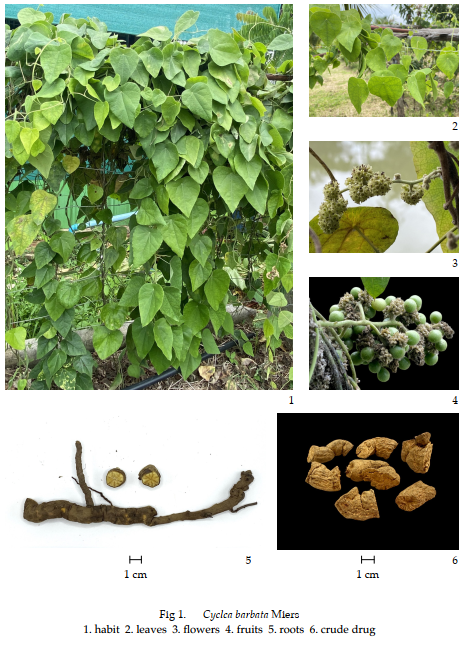
Description of the plant (Fig. 1) Woody climber, up to 8 m long, dioecious; root long and fleshy, non-tuberous, externally pale brown; stem slender, hispid, glabrescent when aged. Leaves simple, spiral, ovate, deltoid-ovate, or broadly ovate, 6 to 17.5 cm long, 4 to 12.5 cm wide, apex acuminate to obtuse, with a finely acumen, base slightly emarginate, truncate, or rounded, margin ciliate with hispid hairs, upper surface hispid or subglabrous, lower surface puberulous to tomentose, occasionally hispid on major nerves, palmately nerved, papyraceous; petiole 3 to 6.5 cm long, hispid, attached 0.6 to 2.5 cm above lamina base. Male inflorescence axillary or cauliflorous, pseudoracemose or thyrsoid, 7 to 12(–30) cm long, 0.5 to 4(–12) cm wide, with spaced, dense, subcapitate clusters of flowers, borne on short lateral branches. Male flower greenish: calyx 4(–5)-lobed, campanulate, 1.5 to 2 mm long, outer surface pilose, lobe triangular; corolla 4-lobed, cup-shaped, about 0.7 mm long, lobe margin truncate or obtuse, glabrous; stamens 4 or 5, connate into a peltate synandrium, 1.5 to 2 mm long, slightly exserted; pedicel minute. Female inflorescence similar to male but usually broader, 11 to 19 cm long, 3 to 7 cm wide, with dense, sessile heads. Female flower: sepals 2, rhomboid to obovate, about 0.5 mm long, about 0.5 mm wide, outer surface pilose; petals 2, opposite to sepal, reniform, about 0.5 mm long, about 1 mm wide, glabrous; ovary superior, densely hispid, stigma 3-lobed, slender. Fruit a drupe, white, obliquely obovoid to rounded, 5 to 7 mm long, 4 to 5.5 mm wide, puberulous; endocarp horseshoe-shaped, with 4 dorsal rows of papilliform tubercles, condyle bordered by a lateral, subentire, curved ridge on each side.
Description Odour, characteristic; taste, bitter.
Macroscopical (Fig. 1) Dried roots, cylindrical, 0.8 to 2 cm in diameter, varied in length, often twisted; externally brownish, rough and wrinkled; internally yellowish to light brown.
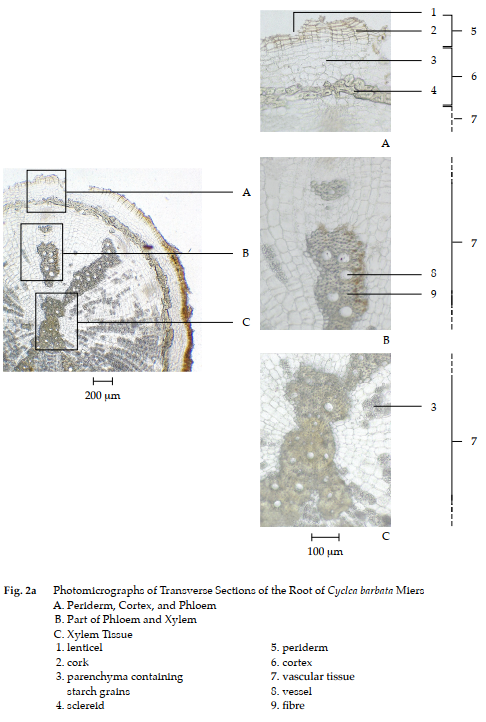
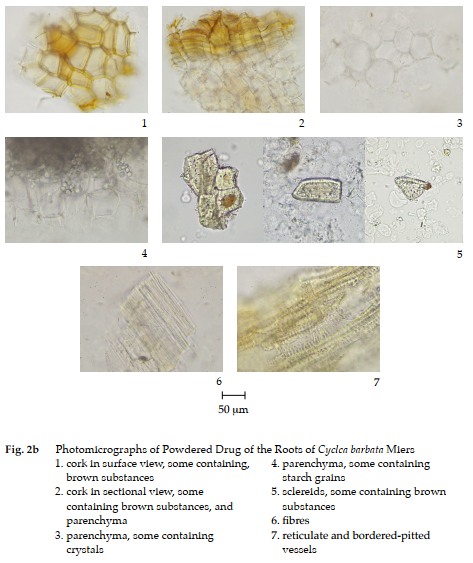
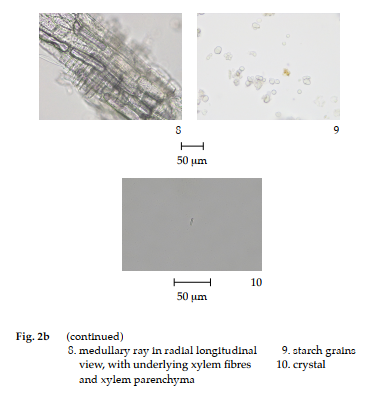
Microscopical (Figs. 2a, 2b) Transverse section of the root shows periderm, cortex, and vascular tissue. Periderm: lenticels and layers of rectangular cork cells, some containing brown substances. Cortex: parenchyma, containing starch grains and crystals; and layers of sclereid ring. Vascular tissue: radially vascular strips; phloem in the outer region; xylem consisting of vessels, fibres, and parenchyma containing simple and compound starch grains and/or crystals; alternating with broad medullary rays.
Cyclea Barbata Root in powder possesses the diagnostic microscopical of the unground drug. Various shapes and sizes of sclereids, some containing brown substances, can be seen in abundance.
Packaging and storage Cyclea Barbata Root shall be kept in well-closed containers, protected from light, and stored in a dry place.
Identification
A. Sonicate 1 g of the sample, in powder, with 10 mL of ethanol for 30 minutes and filter (solution 1). To 1 mL of solution 1, add a few drops of modified Dragendorff TS2 and shake well: an orange precipitate is produced.
B. Sonicate 1 g of the sample, in powder, with 10 mL of water at 70° for 30 minutes and filter (solution 2). To 1 mL of solution 2, add a few drops of ninhydrin TS, mix well, and warm on a water-bath: a violet colour develops.
C. To 1 mL of solution 2, add a few drops of a 1 per cent w/v solution of iron(III) chloride and shake well: a green precipitate is produced.
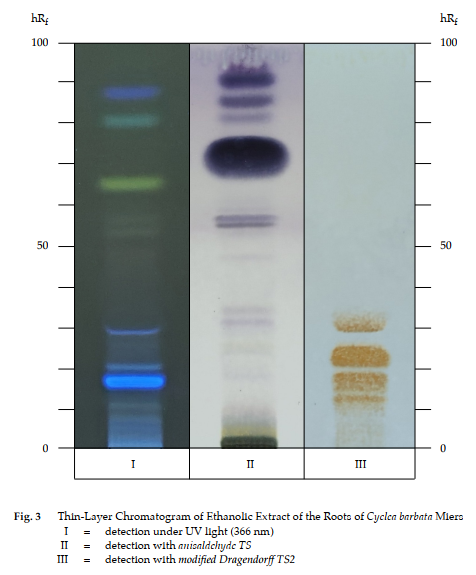
D. Carry out the test as described in the “Thin-Layer Chromatography” (Appendix 3.1), using silica gel G as the coating substance and a mixture of 90 volumes of dichloromethane, 10 volumes of methanol, and 5 volumes of formic acid as the mobile phase and allowing the solvent front to ascend 8 cm above the line of application. Apply to the plate as a band of 10 mm, 20 µL of solution 1. After removal of the plate, allow it to dry in air. Examine the plate under ultraviolet light (366 nm); one violet, one green, one yellow, two orange, and three blue fluorescent bands are observed. Spray the plate with anisaldehyde TS and heat at 105º for 10 minutes. The chromatogram shows nine violet bands (Fig. 3).
Repeat the same procedure on another plate but spray with modified Dragendorff TS2. The chromatogram shows four orange bands (Fig. 3).
Loss on drying Not more than 10.0 per cent w/w after drying at 105° to constant weight (Appendix 4.15).
Foreign matter Not more than 2.0 per cent w/w (Appendix 7.2).
Acid-insoluble ash Not more than 2.0 per cent w/w (Appendix 7.6). Total ash Not more than 6.0 per cent w/w (Appendix 7.7).
Ethanol-soluble extractive Not less than 13.0 per cent w/w (Appendix 7.12).
Water-soluble extractive Not less than 14.0 per cent w/w (Appendix 7.12).
 36 ผู้เข้าชม / View