ตำรามาตรฐานยาสมุนไพรไทย
Thai Herbal Pharmacopoeia
สำนักยาและวัตถุเสพติด กรมวิทยาศาสตร์การแพทย์ กระทรวงสาธารณสุข
Bureau of Drug and Narcotic, Department of Medical Sciences, Ministry of Public Health
สำนักยาและวัตถุเสพติด กรมวิทยาศาสตร์การแพทย์ กระทรวงสาธารณสุข
Bureau of Drug and Narcotic, Department of Medical Sciences, Ministry of Public Health(Tinospora crispa (L.) Hook.f. & Thomson)
(Nelumbo nucifera Gaertn.)
(Centella asiatica (L.) Urb.)
(Centella Dry Extract)
(Centella Cream)
(Mesua ferrea L.)
(Piper sarmentosum Roxb.)
(Piper sarmentosum Roxb.)
(Pterocarpus santalinus L. f.)
(Santalum album L.)
(Senna tora (L.) Roxb.)
(Senna alata (L.) Roxb.)
(Senna Alata Tea)
(Piper retrofractum Vahl)
(Myristica fragrans Houtt)
(Andrographis paniculata (Burm. f.) Nees)
(Andrographis Capsules)
(Allium ascalonicum L.)
(Ocimum tenuiflorum L.)
(Curcuma longa L.)
(Turmeric Capsules)
(Turmeric Dry Extract)
(Turmeric Dry Extract Capsules)
(Arcangelisia flava (L.) Merr.)
(Curcuma sp.)
Harrisonia perforata (Blanco) Merr.
(Aristolochia pierrei Lecomte)
(Zingiber officinale Roscoe)
(Ginger Capsules)
(Ginger Tea)
(Cassia fistula L.)
(Nardostachys jatamansi (D. Don) DC.)
(Angelica sinensis (Oliv.) Diels)
Artemisia annua L.
(Ligusticum sinense Oliv. cv. Chuanxiong)
(Neopicrorhiza scrophulariiflora Pennell)
(Atractylodes lancea (Thunb.) DC.)
(Aucklandia lappa Decne)
(Terminalia chebula Retz.)
(Angelica dahurica (Hoffm.) Benth. & Hook. f. ex Franch. & Sav. var. dahurica)
(Kaempferia parviflora Wall. ex Baker)
(Hibiscus sabdariffa L.)
(Roselle Tea)
(Allium sativum L.)
(Zingiber zerumbet (L.) Sm.)
(Wurfbainia testacea (Ridl.) Škorničk.& A. D. Poulsen)
(Cannabis sativa L.)
(Myristica fragrans Houtt)
(Dracaena cochinchinensis (Lour.) S. C. Chen)
(Ficus racemosa L.)
(Hyptis suaveolens (L.) Poit.)
Clerodendrum indicum (L.) Kuntze
(Phyllanthus emblica L.)
(Citrus hystrix DC.)
(Citrus hystrix DC.)
(Areca catechu L.)
(Momordica charantia L.)
Moringa oleifera Lam.
(Aegle marmelos (L.) Corrêa)
(Solanum trilobatum L.)
(Morus alba L.)
Gynostemma pentaphyllum(Thunb.)
Makino
(Clinacanthus nutans (Burm. f.) Lindau)
(Cissus quadrangularis L.)
(Mimusops elengi L.)
(Zingiber montanum (J. König) Link. ex A. Dietr.)
(Piper betle L.)
(Capsicum annuum L.)
(Capsicum Oleoresin)
(Capsicum Gel)
(Piper nigrum L.)
(Piper nigrum L.)
(Eurycoma longifolia Jack)
(Thunbergia laurifolia Lindl.)
(Piper wallichii (Miq.) Hand.-Mazz.)
Senna garrettiana (Craib) H. S. Irwin & Barneby
(Terminalia bellirica (Gaertn.) Roxb.)
(Terminalia chebula Retz.)
(Caesalpinia bonduc (L.) H. Roxb.)
(Tarlmounia elliptica (DC.) H. Rob., S. C. Keeley, Skvaria & R. Chan)
(Hog Creeper Vine Dry Extract Capsiles)
(Hog Creeper Vine Dry Extract)
(Brachypterum scandens (Roxb.) Miq.)
(Lepidium sativum L.)
(Nigella sativa L.)
(Cuminum cyminum L.)
(Foeniculum vulgare Mill.)
(Plantago ovata Forssk.)
(Pimpinella anisum L.)
(Carum carvi L.)
(Anethum graveolens L.)
(Trachyspermum ammi (L.) Sprague)
Albizia procera (Roxb.) Benth.
(Acorus calamus L.)
(Tiliacora triandra (Colebr.) Diels)
Cyanthillium cinereum (L.) H. Rob.
(Orthosiphon aristatus (Blume) Miq.)
Murdannia loriformis (Hassk.) R. S. Rao & Kammathy
(Capparis micracantha DC.)
(Chrysopogon zizanioides (L.) Roberty)
(Cyperus rotundus L.)
(Cannabis sativa L.)
(Syzygium aromaticum (L.) Merr. & L. M. Perry)
(Boesenbergia rotunda (L.) Mansf.)
(Acanthus ebracteatus Vahl)
(Acanthus ilicifolius L.)
(Kaempferia galanga L.)
(Curcuma comosa Roxb.)
Betula alnoides Buch.-Ham. ex D. Don
Cannabis sativa L.
Carthamus tinctorius L
Mitragyna speciosa (Korth.) Havil
Mallotus repandus (Rottler) Müll. Arg
Azadirachta indica A. Juss. var. siamensis Valeton
Azadirachta indica A. Juss. var. siamensis Valeton
Punica granatum L.
Rhinacanthus nasutus (L.) Kurz
Baliospermum solanifolium (Burm.) Suresh
Curcuma aeruginosa Roxb
Boesenbergia kingii Mood & L. M. Prince
Senegalia rugata (Lam.) Britton & Rose
Acacia concinna (Willd.) DC.
Senegalia rugata (Lam.) Britton & Rose
Acacia concinna (Willd.) DC.
Senna alexandriana Mill. var. alexandriana
Cassia acutifolia Delile, Cassia angustifolia Vahl
Butea superba Roxb. ex Willd.
[Plaso superba (Roxb. ex Willd.) Kuntze, Rudolphia superba (Roxb. ex Willd.) Poir.
Pueraria candollei Graham
ex Benth. var. mirifica (Airy Shaw & Suvat.) Niyomdham
Streblus asper Lour.
Suregada multiflora (A. Juss.) Baill. (Gelonium
multiflorum A. Juss.
Plumbago zeylanica L.
Plumbago indica L.
Biancaea sappan (L.) Tod.
Ziziphus attopensis Pierre
Streblus asper Lour.
Justicia gendarussa Burm. f.
Enhalus acoroides (L. f.) Royle
Bridelia ovata Decne.
Tamarindus indica L.
Citrus × aurantiifolia (Christm.) Swingle
Garcinia mangostana L.
Blumea balsamifera (L.) DC
Persicaria odorata (Lour.) Soják
Zingiber montanum (J. König) Link ex A. Dietr.
Mammea siamensis (Miq.) T. Anderson
Citrus maxima (Burm.) Merr.
Citrus × aurantium L. ‘Som Sa'
Punica granatum L.
Rhinacanthus nasutus (L.) Kurz
Sappan Wood is the dried heartwood of Biancaea sappan (L.) Tod. (Caesalpinia sappan L.) (Family Leguminosae), Herbarium Specimen Number: DMSC 5286, Crude Drug Number: DMSc 1215.
Constituents Sappan Wood contains homoisoflavonoids (e.g., brazilein, brazilin, haematoxylin). It also contains flavonoids, sterols, etc.
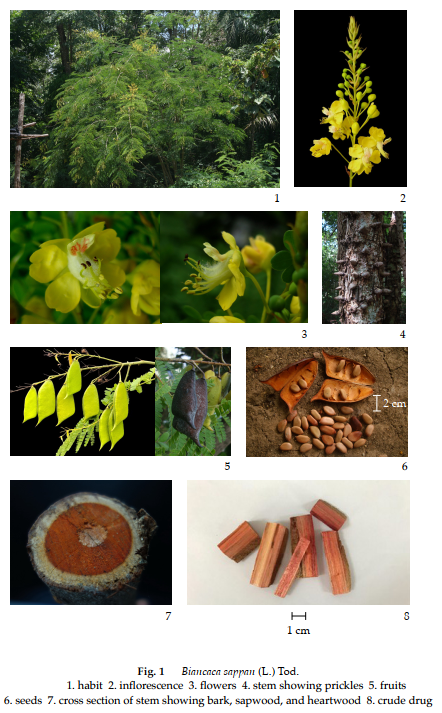
Description of the plant (Fig. 1) Tree or scrambling shrub up to 13 m tall; stem and branch with recurved prickles, conspicuous lenticels. Leaves bipinnately compound, alternate, 20 to 45 cm long; petiole 2.5 to 4 cm long; rachis 15 to 40 cm long, often prickly; pinnae 5 to 18 pairs, opposite, 8 to 12 cm long, leaflets 6 to 20 pairs, opposite, oblong or asymmetrical rhombic, 1 to 2.3 cm long, 0.6 to 1 cm wide, apex round to emarginate, base oblique, margin entire, blade papery, both surfaces glabrous or sparsely hairy; petiolule sessile; stipule 3 to 4 mm long, caducous. Inflorescence paniculate or racemose, axillary or terminal, 10 to 40 cm long; bract lanceolate, 5 to 8 mm long, apex acuminate, hairy, caducous. Flower yellow; pedicel 1.5 to 2 cm long, puberulent or pubescent, jointed near top; sepals 5, imbricate, hood-shaped, 0.7 to 1.2 cm long, 3 to 5 mm wide, unequal, lowest one larger than others, glabrous with ciliate margin; petals 5, broadly ovate to obovate, 0.9 to 1.4 cm long, 0.6 to 1 cm wide, unequal, uppermost one clawed, tinged pink at base, hairy inside towards middle; stamens 10, free, slightly exserted, filament densely pubescent at base; ovary superior, elliptic, pubescent, sessile or shortly stalked, 1-loculed, style slender, hairy, stigma truncate; receptacle shallowly campanulate. Fruit a pod, obliquely oblong, widest towards top, 5 to 12 cm long, 1.5 to 4 cm wide, woody, flattened, apex truncate with prominently beaked, base obtuse, reddish brown to brown when aged, shiny. Seeds 2 to 4, light brown, elliptic-oblong, flattened, 1.5 to 1.8 cm long, 0.8 to 1 cm wide.
Description Odour, mild; taste, slightly bitter.
Macroscopical (Fig. 1) Longitudinal pieces of heartwood, orange-yellowish red to reddish, varied in shape and size; surface, rough.
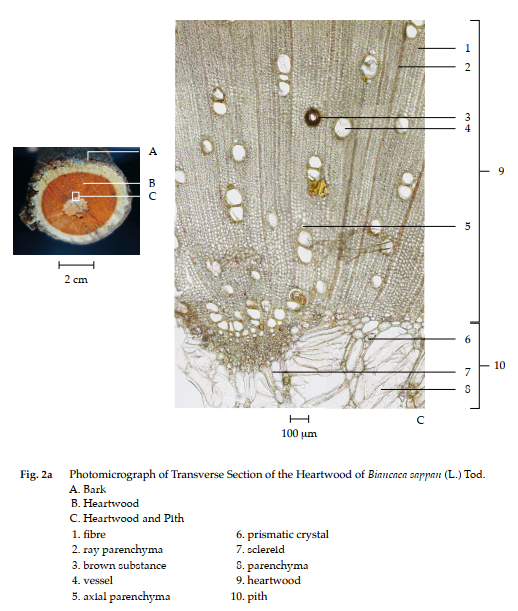
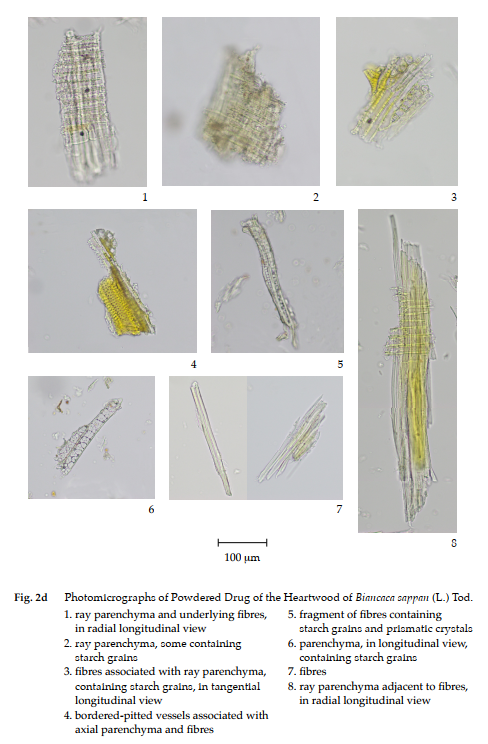
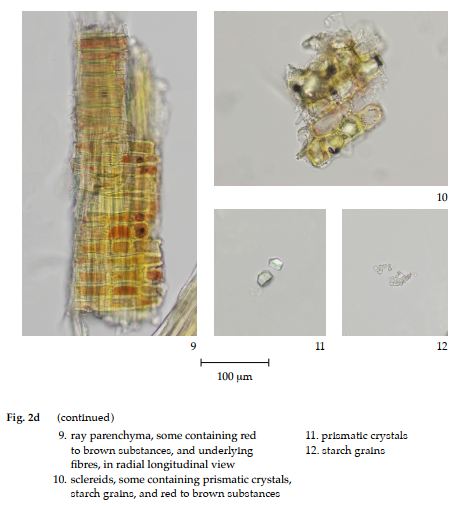
Microscopical (Figs. 2a‒2d) Transverse section of the heartwood shows vessels, axial parenchyma, ray parenchyma, fibres, and pith. Vessel: large, thick-walled cells, scattered, solitary or small cluster of 2 to 3 cells, some containing brown substances. Axial parenchyma: polygonal, thick-walled, arranged circularly around the vessel. Ray parenchyma: 1 to 3 rows, some containing brown substances. Fibre: thick-walled. Pith: parenchyma and sclereids; parenchyma, large, elongated, thin-walled, some containing prismatic crystals and/or brown substances; sclereid, large, elongated, thick- and pitted-walled.
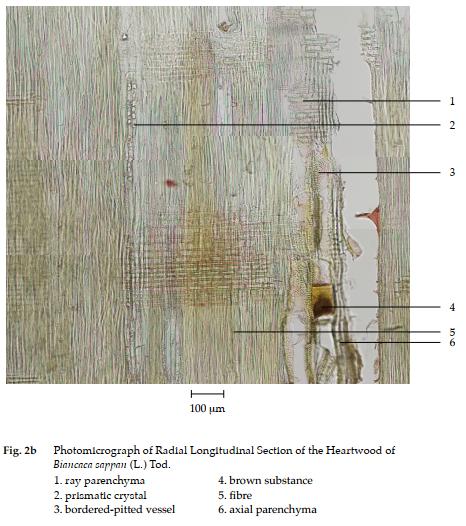
Radial longitudinal section of the heartwood shows vessels, axial parenchyma, ray parenchyma, and fibres. Vessel: large, with bordered-pitted and simple perforation plate, some containing brown substances. Axial parenchyma: elongated, thick-walled cells, some containing prismatic crystals, and/or starch grains, and/or brown substances. Ray parenchyma: multiseriate, thick-walled, rectangular cells, some containing prismatic crystals, and/or brown substances, and/or starch grains. Fibre: thick-walled.
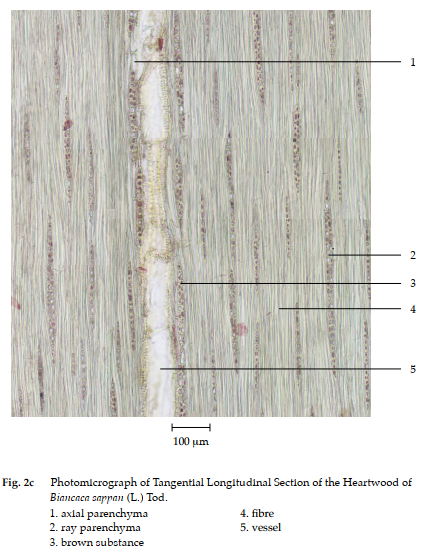
Tangential longitudinal section of the heartwood shows vessels, axial parenchyma, ray parenchyma, and fibres. Vessel: large, with bordered-pitted and simple perforation plate, some containing brown substances. Axial parenchyma: thick-walled, elongated cells, some containing prismatic crystals, and/or starch grains, and/or brown substances. Ray parenchyma: 1 to 3 rows, thick-walled, oval cells, some containing brown substances. Fibre: thick-walled.
Sappan Wood in powder possesses the diagnostic microscopical characters of the unground drug. Fibres containing starch grains and ray parenchyma containing red to brown substances are characteristics. Various views of ray parenchyma and large bordered-pitted vessels are commonly observed. Starch grains, prismatic crystals, and red to brown substances can also be seen.
Packaging and storage Sappan Wood shall be kept in well-closed containers, protected from light, and stored in a dry place.
Identification
A. Macerate 500 mg of the sample, in fine powder, with 10 mL of ethanol for 5 minutes and filter. To 2 mL of the filtrate, add 2 mL of a 1 per cent w/v solution of sodium carbonate and mix: a dark red colour develops.
B. Macerate 100 mg of the sample, in fine powder, with 10 mL of ethanol for 15 minutes and filter. Mix 2 mL of the filtrate with 2 or 3 pieces of magnesium ribbon and a few drops of hydrochloric acid: a pink colour develops.
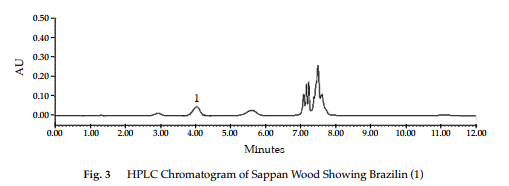
C. The chromatogram of the Sample preparation shows several peaks, one of which corresponds to the brazilin peak of the Standard preparation, as obtained in the Brazilin content (Fig. 3).
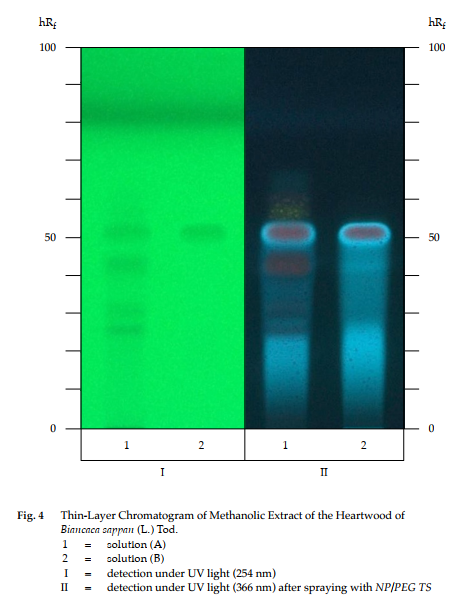
D. Carry out the test as described in the “Thin-Layer Chromatography” (Appendix 3.1), using a high-performance plate with silica gel GF254 as the coating substance and a mixture of 60 volumes of chloroform, 40 volumes of acetone, and 5 volumes of formic acid as the mobile phase and allowing the solvent front to ascend 8 cm above the line of application. Apply separately to the plate as bands of 8 mm, 5 μL of solution (A) and 3 μL of solution (B). Prepare solution (A) by macerating 100 mg of the sample, in fine powder, with 5 mL of methanol for 10 minutes and filtering. For solution (B) dissolve 1 mg of brazilin in 5 mL of methanol. After removal of the plate, allow it to dry in air and examine under ultraviolet light (254 nm), marking the quenching bands. The chromatogram obtained from solution (A) shows a quenching band (hRfvalue 49 to 53) corresponding to brazilin from solution (B) and other three quenching bands are also observed. Heat the plate at 80° for 10 minutes and then spray with natural products (NP) TS while the plate is still warm. Subsequently spray the plate with polyethyleneglycol (PEG) TS and observe the colours of the bands under ultraviolet light (366 nm) through the cut-off filter within 5 to 15 minutes; the band due to brazilin is red-brown fluorescent. One red-brown, one yellow, and two dark fluorescent bands are also observed (Fig. 4).
Loss on drying Not more than 7.0 per cent w/w after drying at 105º to constant weight (Appendix 4.15).
Foreign matter Not more than 2.0 per cent w/w (Appendix 7.2).
Total ash Not more than 1.0 per cent w/w (Appendix 7.7).
Ethanol-soluble extractive Not less than 7.0 per cent w/w (Appendix 7.12).
Water-soluble extractive Not less than 4.0 per cent w/w (Appendix 7.12).
Brazilin content Not less than 0.7 per cent w/w of brazilin (C16H14O5). Carry out the determination as described in the “Liquid Chromatography” (Appendix 3.5).
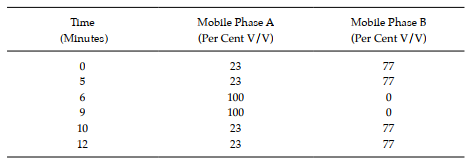
Mobile phase A Use methanol.
Mobile phase B Prepare a 0.3 per cent v/v solution of glacial acetic acid.
Standard preparation Dissolve an accurately weighed quantity of Brazilin RS in methanol to obtain a solution containing 200 µg per mL.
Sample preparation Sonicate about 100 mg of Sappan Wood, in fine powder and accurately weighed, with 10.0 mL of methanol for 30 minutes and filter through a membrane having a 0.45-μm porosity.
The step gradient of mobile phases is as follows:
Chromatographic system The chromatographic procedure may be carried out using (a) a stainless steel column (15 cm × 4.6 mm) packed with octadecylsilane chemically bonded to porous silica or ceramic microparticles (2.7 μm), equipped with a similarly packed guard column and maintained at a temperature of 27°, (b) Mobile phase at a flow rate of about 1.4 mL per minute, and (c) an ultraviolet photometer set at 290 nm.
To determine the suitability of the chromatographic system, chromatograph Standard preparation and record the peak response as directed under Procedure: the relative standard deviation for replicate injections is not more than 2.0 per cent.
Procedure Separately inject about 10 μL each of Standard preparation and Sample preparation into the chromatograph, record the chromatograms, and measure the responses for the major peaks.
Calculation Calculate the content of C16H14O5 in the portion of the Sappan Wood taken, using the declared content of C16H14O5 in Brazilin RS.
 979 ผู้เข้าชม / View