ตำรามาตรฐานยาสมุนไพรไทย
Thai Herbal Pharmacopoeia
สำนักยาและวัตถุเสพติด กรมวิทยาศาสตร์การแพทย์ กระทรวงสาธารณสุข
Bureau of Drug and Narcotic, Department of Medical Sciences, Ministry of Public Health
สำนักยาและวัตถุเสพติด กรมวิทยาศาสตร์การแพทย์ กระทรวงสาธารณสุข
Bureau of Drug and Narcotic, Department of Medical Sciences, Ministry of Public Health(Tinospora crispa (L.) Hook.f. & Thomson)
(Nelumbo nucifera Gaertn.)
(Centella asiatica (L.) Urb.)
(Centella Dry Extract)
(Centella Cream)
(Mesua ferrea L.)
(Piper sarmentosum Roxb.)
(Piper sarmentosum Roxb.)
(Pterocarpus santalinus L. f.)
(Santalum album L.)
(Senna tora (L.) Roxb.)
(Senna alata (L.) Roxb.)
(Senna Alata Tea)
(Piper retrofractum Vahl)
(Myristica fragrans Houtt)
(Andrographis paniculata (Burm. f.) Nees)
(Andrographis Capsules)
(Allium ascalonicum L.)
(Ocimum tenuiflorum L.)
(Curcuma longa L.)
(Turmeric Capsules)
(Turmeric Dry Extract)
(Turmeric Dry Extract Capsules)
(Arcangelisia flava (L.) Merr.)
(Curcuma sp.)
Harrisonia perforata (Blanco) Merr.
(Aristolochia pierrei Lecomte)
(Zingiber officinale Roscoe)
(Ginger Capsules)
(Ginger Tea)
(Cassia fistula L.)
(Nardostachys jatamansi (D. Don) DC.)
(Angelica sinensis (Oliv.) Diels)
Artemisia annua L.
(Ligusticum sinense Oliv. cv. Chuanxiong)
(Neopicrorhiza scrophulariiflora Pennell)
(Atractylodes lancea (Thunb.) DC.)
(Aucklandia lappa Decne)
(Terminalia chebula Retz.)
(Angelica dahurica (Hoffm.) Benth. & Hook. f. ex Franch. & Sav. var. dahurica)
(Kaempferia parviflora Wall. ex Baker)
(Hibiscus sabdariffa L.)
(Roselle Tea)
(Allium sativum L.)
(Zingiber zerumbet (L.) Sm.)
(Wurfbainia testacea (Ridl.) Škorničk.& A. D. Poulsen)
(Cannabis sativa L.)
(Myristica fragrans Houtt)
(Dracaena cochinchinensis (Lour.) S. C. Chen)
(Ficus racemosa L.)
(Hyptis suaveolens (L.) Poit.)
Clerodendrum indicum (L.) Kuntze
(Phyllanthus emblica L.)
(Citrus hystrix DC.)
(Citrus hystrix DC.)
(Areca catechu L.)
(Momordica charantia L.)
Moringa oleifera Lam.
(Aegle marmelos (L.) Corrêa)
(Solanum trilobatum L.)
(Morus alba L.)
Gynostemma pentaphyllum(Thunb.)
Makino
(Clinacanthus nutans (Burm. f.) Lindau)
(Cissus quadrangularis L.)
(Mimusops elengi L.)
(Zingiber montanum (J. König) Link. ex A. Dietr.)
(Piper betle L.)
(Capsicum annuum L.)
(Capsicum Oleoresin)
(Capsicum Gel)
(Piper nigrum L.)
(Piper nigrum L.)
(Eurycoma longifolia Jack)
(Thunbergia laurifolia Lindl.)
(Piper wallichii (Miq.) Hand.-Mazz.)
Senna garrettiana (Craib) H. S. Irwin & Barneby
(Terminalia bellirica (Gaertn.) Roxb.)
(Terminalia chebula Retz.)
(Caesalpinia bonduc (L.) H. Roxb.)
(Tarlmounia elliptica (DC.) H. Rob., S. C. Keeley, Skvaria & R. Chan)
(Hog Creeper Vine Dry Extract Capsiles)
(Hog Creeper Vine Dry Extract)
(Brachypterum scandens (Roxb.) Miq.)
(Lepidium sativum L.)
(Nigella sativa L.)
(Cuminum cyminum L.)
(Foeniculum vulgare Mill.)
(Plantago ovata Forssk.)
(Pimpinella anisum L.)
(Carum carvi L.)
(Anethum graveolens L.)
(Trachyspermum ammi (L.) Sprague)
Albizia procera (Roxb.) Benth.
(Acorus calamus L.)
(Tiliacora triandra (Colebr.) Diels)
Cyanthillium cinereum (L.) H. Rob.
(Orthosiphon aristatus (Blume) Miq.)
Murdannia loriformis (Hassk.) R. S. Rao & Kammathy
(Capparis micracantha DC.)
(Chrysopogon zizanioides (L.) Roberty)
(Cyperus rotundus L.)
(Cannabis sativa L.)
(Syzygium aromaticum (L.) Merr. & L. M. Perry)
(Boesenbergia rotunda (L.) Mansf.)
(Acanthus ebracteatus Vahl)
(Acanthus ilicifolius L.)
(Kaempferia galanga L.)
(Curcuma comosa Roxb.)
Betula alnoides Buch.-Ham. ex D. Don
Cannabis sativa L.
Carthamus tinctorius L
Mitragyna speciosa (Korth.) Havil
Mallotus repandus (Rottler) Müll. Arg
Azadirachta indica A. Juss. var. siamensis Valeton
Azadirachta indica A. Juss. var. siamensis Valeton
Punica granatum L.
Rhinacanthus nasutus (L.) Kurz
Baliospermum solanifolium (Burm.) Suresh
Curcuma aeruginosa Roxb
Boesenbergia kingii Mood & L. M. Prince
Senegalia rugata (Lam.) Britton & Rose
Acacia concinna (Willd.) DC.
Senegalia rugata (Lam.) Britton & Rose
Acacia concinna (Willd.) DC.
Senna alexandriana Mill. var. alexandriana
Cassia acutifolia Delile, Cassia angustifolia Vahl
Butea superba Roxb. ex Willd.
[Plaso superba (Roxb. ex Willd.) Kuntze, Rudolphia superba (Roxb. ex Willd.) Poir.
Pueraria candollei Graham
ex Benth. var. mirifica (Airy Shaw & Suvat.) Niyomdham
Streblus asper Lour.
Suregada multiflora (A. Juss.) Baill. (Gelonium
multiflorum A. Juss.
Plumbago zeylanica L.
Plumbago indica L.
Biancaea sappan (L.) Tod.
Ziziphus attopensis Pierre
Streblus asper Lour.
Justicia gendarussa Burm. f.
Enhalus acoroides (L. f.) Royle
Bridelia ovata Decne.
Tamarindus indica L.
Citrus × aurantiifolia (Christm.) Swingle
Garcinia mangostana L.
Blumea balsamifera (L.) DC
Persicaria odorata (Lour.) Soják
Zingiber montanum (J. König) Link ex A. Dietr.
Mammea siamensis (Miq.) T. Anderson
Citrus maxima (Burm.) Merr.
Citrus × aurantium L. ‘Som Sa'
Punica granatum L.
Rhinacanthus nasutus (L.) Kurz
Trichosanthes scabra Lour.
Cardiospermum halicacabum L.
Vitex negundo L.
Cyclea barbata Miers
Fingerroot Soft Extract
Artocarpus heterophyllus Lam.
Abutilon indicum (L.) Sweet
Averrhoa carambola L.
Senna alexandrina Mill. var. alexandrina
Alexandrian Senna Pod Capsules
Alexandrian Senna Pod Tea
Euphorbia hirta L.
Gymnema inodorum (Lour.) Decne.
Cleome viscosa L.
Ardisia elliptica Thunb.
Asparagus racemosus Willd.
Nymphaea rubra Roxb. ex Andrews
Lawsonia inermis L.
Java Tea Dry Extract
Java Tea Capsules
Java Tea Tea
Gymnema Inodorum Leaf is the dried leaf of Gymnema inodorum (Lour.) Decne. [G. tingens (Roxb.) Spreng.] (Family Apocynaceae), Herbarium Specimen Number: DMSC 5425, Crude Drug Number: DMSc 1279.
Constituents Gymnema Inodorum Leaf contains flavonoids, phenolics, triterpenoid saponins, etc.
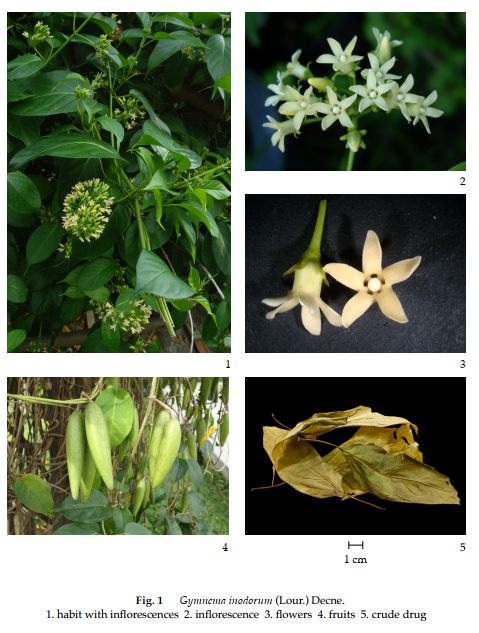
Description of the plant (Fig. 1) Woody climber, up to 10 m tall; stem terete, glabrous, lenticellate, all parts with white latex. Leaves simple, opposite decussate, ovate to ovateoblong, 4 to 13(‒17) cm long, 2 to 10 cm wide, apex acuminate to caudate, base rounded to shallowly cordate, margin entire, membranaceous, lateral veins 5 to 6(‒7) pairs, sparsely puberulent on major veins on both surfaces; petiole 1.5 to 3 cm long. Inflorescence terminal and axillary, raceme with umbel-like cymes, up to 4 cm long; peduncle 2 to 5 cm long. Flower with pedicel 1 to 1.5 cm long; calyx 5-lobed, oblong, 2 to 3 mm long, about 1.4 mm wide, puberulent; corolla creamish, 5-lobed, minutely puberulent outside, lobe oblong, 3 to 4 mm long, 1.6 to 1.8 mm wide, apex rounded or broadly acute, margin ciliate, tube cylindric, about 3 mm long, glabrous except for longitudinal bands of stiff hairs alternating with lobes, sparsely pubescent outside; stamens 5, pollinia oblong, about 0.5 mm long, about 0.2 mm wide, opposite to corolla lobes; pistil head dome-shaped, slightly exserted from corolla, ovary superior, 2 free carpels, ovule numerous. Fruit a follicle, fusiform, 10 to 15 cm long, 2 to 3 cm wide, pericarp fibrous, glabrous. Seeds numerous, glabrous, ovate, obovate or ovate-oblong, 1 to 1.5 cm long, 3 to 5 mm wide; coma silky, 3 to 5 cm long, pointing towards apex of follicle.
Description Odour mild; taste bitter.
Macroscopical (Fig. 1) Whole or broken leaves; whole leaf petiolate, greenish to brown, ovate-oblong to ovate, apex acuminate, margin entire, both sides glabrous.
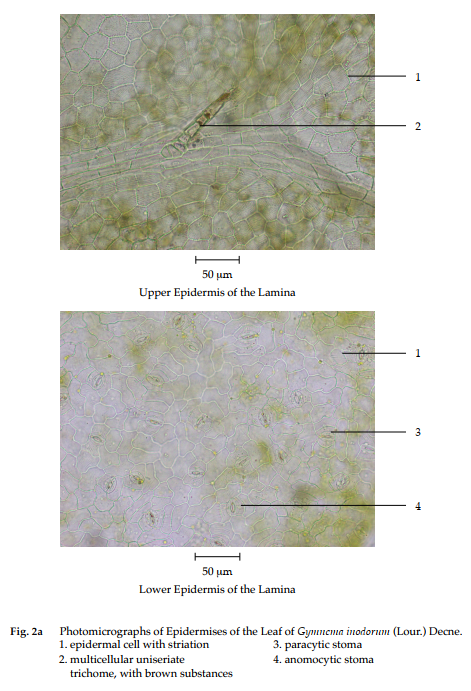
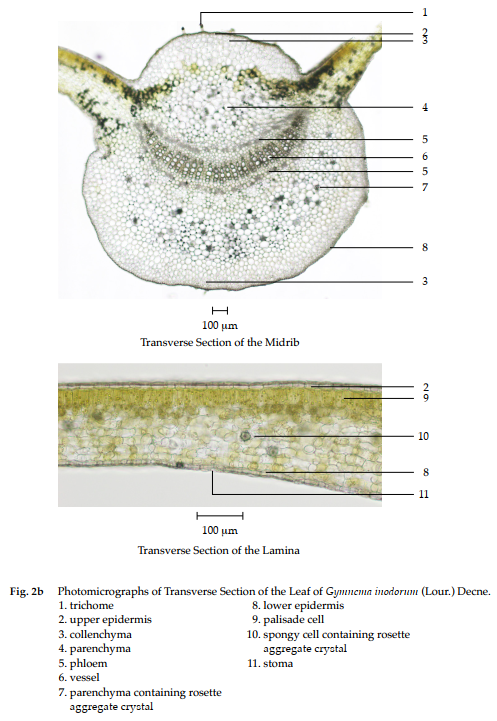
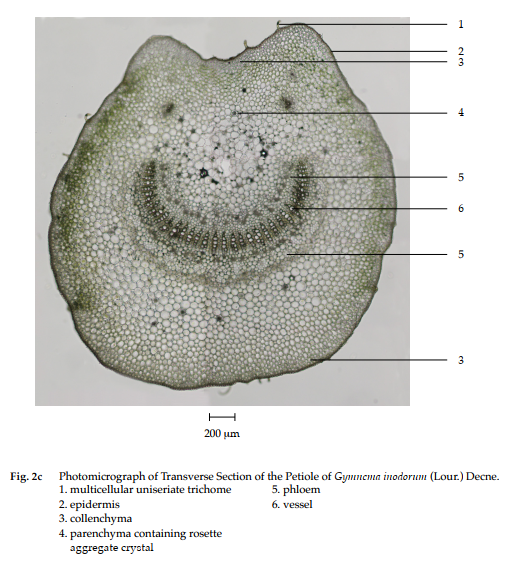
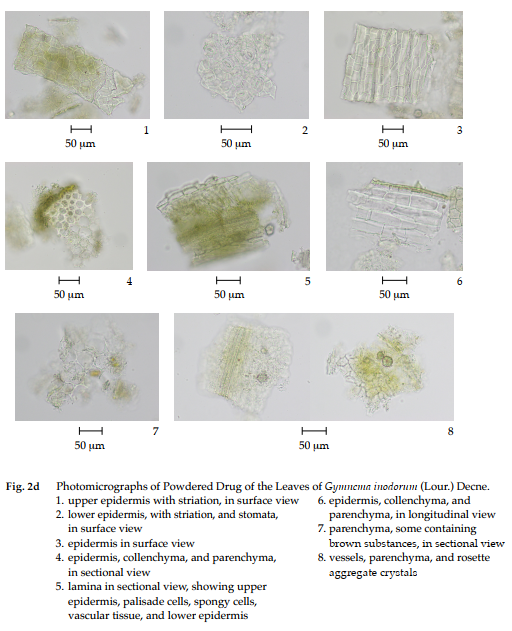
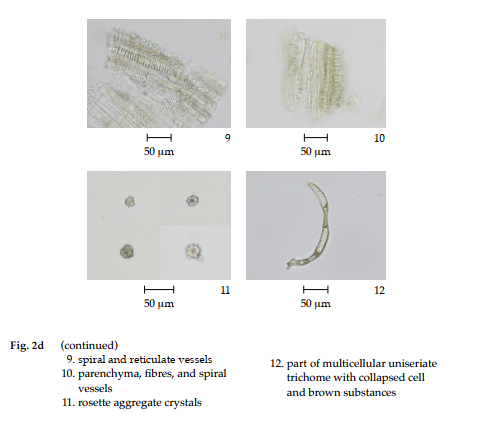
Microscopical (Figs. 2a‒2d) Transverse section of the leaf through the midrib shows upper epidermis, mesophyll, vascular tissue, and lower epidermis. Upper epidermis: a layer of oblong cells with cuticle, and multicellular uniseriate trichomes with brown substances. Mesophyll: 1 to 2 layers of cylindrical palisade cells, spongy cells, some containing rosette aggregate crystals; collenchyma and parenchyma, some containing rosette aggregate crystals in midrib. Vascular tissue: phloem and xylem. Lower epidermis: a layer of epidermal cells with cuticle, multicellular uniseriate trichomes, and stomata.
Transverse section of the petiole shows epidermis, cortex, and vascular tissue. Epidermis: a layer of small epidermal cells and multicellular uniseriate trichomes. Cortex: several layers of angular collenchyma, and parenchyma, some containing rosette aggregate crystals. Vascular tissue: phloem and xylem.
Gymnema Inodorum Leaf in powder possesses the diagnostic microscopical of the unground drug. Multicellular uniseriate trichomes with brown substances, some of which with collapsed cells, are characteristic. Epidermal layer with striation is unique.
Packaging and storage Gymnema Inodorum Leaf shall be kept in well-closed containers, protected from light, and stored in a dry place.
Identification
A. Reflux 1 g of the sample, in powder, with 25 mL of ethanol for 20 minutes and filter. Shake the filtrate thoroughly with 200 mg of activated charcoal, warm on a water-bath for 5 minutes, and filter (solution 1). To 2 mL of solution 1, add 1 drop of a 1 per cent w/v solution of iron(III) chloride and shake well: a bluish black colour is produced.
B. To 2 mL of solution 1, add 2 pieces of magnesium ribbon, shake well, mix with a few drops of hydrochloric acid, and warm on a water-bath for 5 minutes: an orangish red colour develops.
C. Evaporate 2 mL of solution 1 to dryness and dissolve the residue in 2 mL of chloroform. Slowly add 1 mL of sulfuric acid to form two layers: a reddish brown ring forms at the zone of contact.
D. Shake vigorously 500 mg of the sample, in powder, with 10 mL of water: a persistent foam is produced for over 30 minutes.
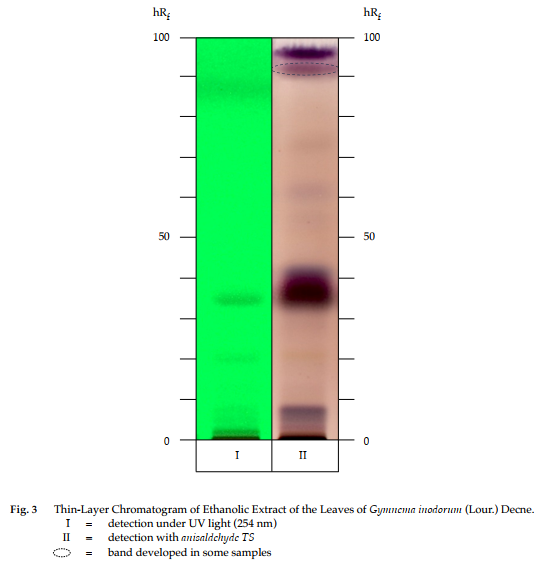
E. Carry out the test as described in the “Thin-Layer Chromatography” (Appendix 3.1), using a high-performance plate silica gel GF254 as the coating substance and a mixture of 84 volumes of hexane and 16 volumes of ethyl acetate as the mobile phase and allowing the solvent front to ascend 8 cm above the line of application. Apply to the plate as a band of 6 mm, 3 μL of the test solution, prepared by refluxing 1 g of the sample, in powder, with 25 mL of ethanol and filtering. Evaporate the filtrate to dryness and dissolve the residue in 3 mL of ethanol. After removal of the plate, allow it to dry in air. Examine the plate under ultraviolet light (254 nm), marking the quenching bands. Spray the plate with anisaldehyde TS and heat at 105° for 10 minutes; one green, four purple, and four violet bands are observed (Fig. 3).
Loss on drying Not more than 9.0 per cent w/w after drying at 105° to constant weight (Appendix 4.15).
Foreign matter Not more than 2.0 per cent w/w (Appendix 7.2).
Acid-insoluble ash Not more than 2.0 per cent w/w (Appendix 7.6).
Total ash Not more than 15.0 per cent w/w (Appendix 7.7).
Ethanol-soluble extractive Not less than 15.0 per cent w/w (Appendix 7.12).
Water-soluble extractive Not less than 30.0 per cent w/w (Appendix 7.12).
 14 ผู้เข้าชม / View