ตำรามาตรฐานยาสมุนไพรไทย
Thai Herbal Pharmacopoeia
สำนักยาและวัตถุเสพติด กรมวิทยาศาสตร์การแพทย์ กระทรวงสาธารณสุข
Bureau of Drug and Narcotic, Department of Medical Sciences, Ministry of Public Health
สำนักยาและวัตถุเสพติด กรมวิทยาศาสตร์การแพทย์ กระทรวงสาธารณสุข
Bureau of Drug and Narcotic, Department of Medical Sciences, Ministry of Public Health(Tinospora crispa (L.) Hook.f. & Thomson)
(Nelumbo nucifera Gaertn.)
(Centella asiatica (L.) Urb.)
(Centella Dry Extract)
(Centella Cream)
(Mesua ferrea L.)
(Piper sarmentosum Roxb.)
(Piper sarmentosum Roxb.)
(Pterocarpus santalinus L. f.)
(Santalum album L.)
(Senna tora (L.) Roxb.)
(Senna alata (L.) Roxb.)
(Senna Alata Tea)
(Piper retrofractum Vahl)
(Myristica fragrans Houtt)
(Andrographis paniculata (Burm. f.) Nees)
(Andrographis Capsules)
(Allium ascalonicum L.)
(Ocimum tenuiflorum L.)
(Curcuma longa L.)
(Turmeric Capsules)
(Turmeric Dry Extract)
(Turmeric Dry Extract Capsules)
(Arcangelisia flava (L.) Merr.)
(Curcuma sp.)
Harrisonia perforata (Blanco) Merr.
(Aristolochia pierrei Lecomte)
(Zingiber officinale Roscoe)
(Ginger Capsules)
(Ginger Tea)
(Cassia fistula L.)
(Nardostachys jatamansi (D. Don) DC.)
(Angelica sinensis (Oliv.) Diels)
Artemisia annua L.
(Ligusticum sinense Oliv. cv. Chuanxiong)
(Neopicrorhiza scrophulariiflora Pennell)
(Atractylodes lancea (Thunb.) DC.)
(Aucklandia lappa Decne)
(Terminalia chebula Retz.)
(Angelica dahurica (Hoffm.) Benth. & Hook. f. ex Franch. & Sav. var. dahurica)
(Kaempferia parviflora Wall. ex Baker)
(Hibiscus sabdariffa L.)
(Roselle Tea)
(Allium sativum L.)
(Zingiber zerumbet (L.) Sm.)
(Wurfbainia testacea (Ridl.) Škorničk.& A. D. Poulsen)
(Cannabis sativa L.)
(Myristica fragrans Houtt)
(Dracaena cochinchinensis (Lour.) S. C. Chen)
(Ficus racemosa L.)
(Hyptis suaveolens (L.) Poit.)
Clerodendrum indicum (L.) Kuntze
(Phyllanthus emblica L.)
(Citrus hystrix DC.)
(Citrus hystrix DC.)
(Areca catechu L.)
(Momordica charantia L.)
Moringa oleifera Lam.
(Aegle marmelos (L.) Corrêa)
(Solanum trilobatum L.)
(Morus alba L.)
Gynostemma pentaphyllum(Thunb.)
Makino
(Clinacanthus nutans (Burm. f.) Lindau)
(Cissus quadrangularis L.)
(Mimusops elengi L.)
(Zingiber montanum (J. König) Link. ex A. Dietr.)
(Piper betle L.)
(Capsicum annuum L.)
(Capsicum Oleoresin)
(Capsicum Gel)
(Piper nigrum L.)
(Piper nigrum L.)
(Eurycoma longifolia Jack)
(Thunbergia laurifolia Lindl.)
(Piper wallichii (Miq.) Hand.-Mazz.)
Senna garrettiana (Craib) H. S. Irwin & Barneby
(Terminalia bellirica (Gaertn.) Roxb.)
(Terminalia chebula Retz.)
(Caesalpinia bonduc (L.) H. Roxb.)
(Tarlmounia elliptica (DC.) H. Rob., S. C. Keeley, Skvaria & R. Chan)
(Hog Creeper Vine Dry Extract Capsiles)
(Hog Creeper Vine Dry Extract)
(Brachypterum scandens (Roxb.) Miq.)
(Lepidium sativum L.)
(Nigella sativa L.)
(Cuminum cyminum L.)
(Foeniculum vulgare Mill.)
(Plantago ovata Forssk.)
(Pimpinella anisum L.)
(Carum carvi L.)
(Anethum graveolens L.)
(Trachyspermum ammi (L.) Sprague)
Albizia procera (Roxb.) Benth.
(Acorus calamus L.)
(Tiliacora triandra (Colebr.) Diels)
Cyanthillium cinereum (L.) H. Rob.
(Orthosiphon aristatus (Blume) Miq.)
Murdannia loriformis (Hassk.) R. S. Rao & Kammathy
(Capparis micracantha DC.)
(Chrysopogon zizanioides (L.) Roberty)
(Cyperus rotundus L.)
(Cannabis sativa L.)
(Syzygium aromaticum (L.) Merr. & L. M. Perry)
(Boesenbergia rotunda (L.) Mansf.)
(Acanthus ebracteatus Vahl)
(Acanthus ilicifolius L.)
(Kaempferia galanga L.)
(Curcuma comosa Roxb.)
Betula alnoides Buch.-Ham. ex D. Don
Cannabis sativa L.
Carthamus tinctorius L
Mitragyna speciosa (Korth.) Havil
Mallotus repandus (Rottler) Müll. Arg
Azadirachta indica A. Juss. var. siamensis Valeton
Azadirachta indica A. Juss. var. siamensis Valeton
Punica granatum L.
Rhinacanthus nasutus (L.) Kurz
Baliospermum solanifolium (Burm.) Suresh
Curcuma aeruginosa Roxb
Boesenbergia kingii Mood & L. M. Prince
Senegalia rugata (Lam.) Britton & Rose
Acacia concinna (Willd.) DC.
Senegalia rugata (Lam.) Britton & Rose
Acacia concinna (Willd.) DC.
Senna alexandriana Mill. var. alexandriana
Cassia acutifolia Delile, Cassia angustifolia Vahl
Butea superba Roxb. ex Willd.
[Plaso superba (Roxb. ex Willd.) Kuntze, Rudolphia superba (Roxb. ex Willd.) Poir.
Pueraria candollei Graham
ex Benth. var. mirifica (Airy Shaw & Suvat.) Niyomdham
Streblus asper Lour.
Suregada multiflora (A. Juss.) Baill. (Gelonium
multiflorum A. Juss.
Plumbago zeylanica L.
Plumbago indica L.
Biancaea sappan (L.) Tod.
Ziziphus attopensis Pierre
Streblus asper Lour.
Justicia gendarussa Burm. f.
Enhalus acoroides (L. f.) Royle
Bridelia ovata Decne.
Tamarindus indica L.
Citrus × aurantiifolia (Christm.) Swingle
Garcinia mangostana L.
Blumea balsamifera (L.) DC
Persicaria odorata (Lour.) Soják
Zingiber montanum (J. König) Link ex A. Dietr.
Mammea siamensis (Miq.) T. Anderson
Citrus maxima (Burm.) Merr.
Citrus × aurantium L. ‘Som Sa'
Punica granatum L.
Rhinacanthus nasutus (L.) Kurz
Lime Peel is the dried exocarp with unremovable mesocarp of Citrus × aurantiifolia (Christm.) Swingle [C. × javanica Blume, C. × medica f. aurantiifolium (Christm.) M. Hiroe, Limonia × aurantiifolia Christm.] (Family Rutaceae), Herbarium Specimen Number: DMSC 5329, Crude Drug Number: DMSc 1261.
Constituents Lime Peel contains volatile oils consisting of limonene, β-pinene, and α-terpineol. It also contains limonoids and flavonoids, i.e., hesperidin. Other compounds are coumarins, phenolic acids, carotenoids, etc.
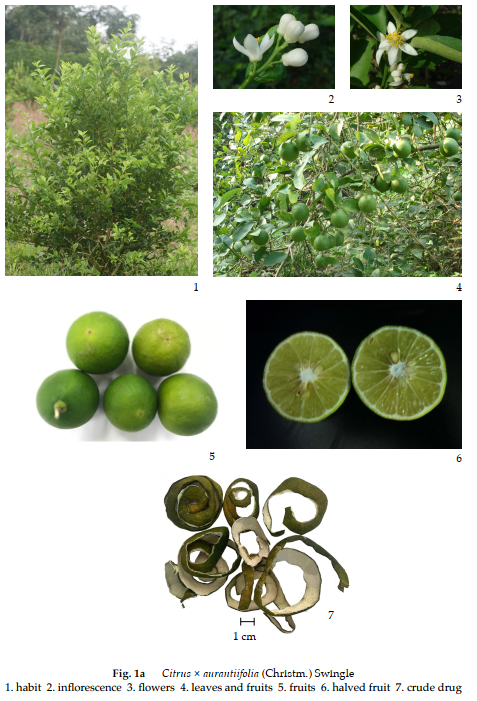
Description of the plant (Fig. 1) Shrub or small tree, 0.5 to 5(–8) m tall, much branched; stem glabrous; branchlets compressed-angular when young, spiny; spines numerous. Leaves unifoliolate, alternate or spirally arranged, elliptic, elliptic-oblong, oblong-ovate, or ovate, 2 to 8(–11) cm long, 1 to 5.5 cm wide, apex acute, obtuse to cuneate, base cuneate or obtuse to rounded, margin entire to crenulate, subcoriaceous, shiny, with scattered pellucid dots; petiole broadly winged, triangular, obovate, or oblanceolate, 2 to 3 cm long, 2 to 9 mm wide. Inflorescence axillary or terminal, raceme, cyme, or solitary, 7(–15)-flowered in fascicled, fragrant; peduncle 3 to 5 mm long. Flower white to yellowish white; pedicel 2 to 5 mm long; calyx cupular, 2 to 3 mm long, 4- to 5-lobed, lobe broadly triangular or ovate, about 1 mm long, fleshy, glabrous or puberulent; petals 4 to 5, oblanceolate, oblong-lanceolate, oblong, or ovate, 0.7 to 1.5 cm long, 2.5 to 5 cm wide, apex acute, fleshy, reflexed at anthesis; stamens white, numerous, filament 2 to 6 mm long, polyadelphous, anther bright yellow, oblong, linear, to linear-sagittate, 2 to 3 mm long, intrastaminal disc about 1 mm high; ovary superior, style white, 2 to 3 mm long, glabrous, caducous, stigma capitate, bright yellow. Fruit a hesperidium, ellipsoid, obovoid to globose, 2.5 to 6 cm in diameter, sometimes with apical papilla; exocarp thin, glabrous, glossy, greenish when young, turning greenish yellow to yellowish when ripe; mesocarp white, spongy; segments 9 to 12; fruit-pulp pale greenish, juicy, sour, aromatic. Seeds whitish, few to numerous, elliptic-oblong to ovoid, about 5 mm long.
Description Odour, aromatic, characteristic; taste, slightly bitter.
Macroscopical (Fig. 1) Dried external peels with some unremovable mesocarp, varied in shape and size; outer surface, yellowish green to brownish green, slightly rough, hard, brittle; inner surface whitish to pale yellowish.
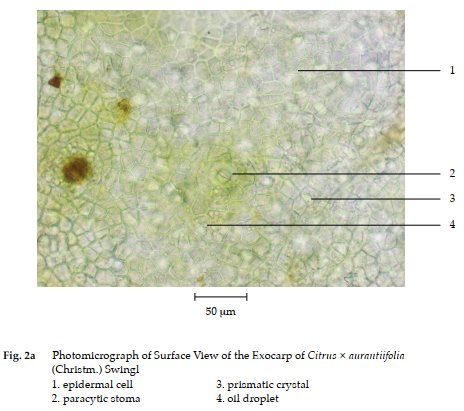
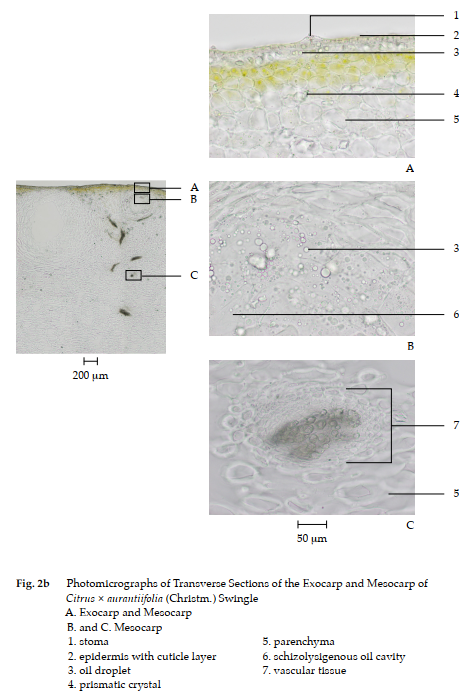
Microscopical (Figs. 2a–2c) Transverse section of the peel shows exocarp with some unremovable mesocarp. Exocarp: a layer of rectangular epidermal cells containing yellowish green substances and some containing prismatic crystals or oil droplets, and stomata, covered with thick cuticle layer. Mesocarp: parenchyma, several layers of slightly thick-walled cells, some containing yellowish green substances, oil droplets or prismatic crystals; schizolysigenous oil cavities; vascular tissue, phloem and xylem.
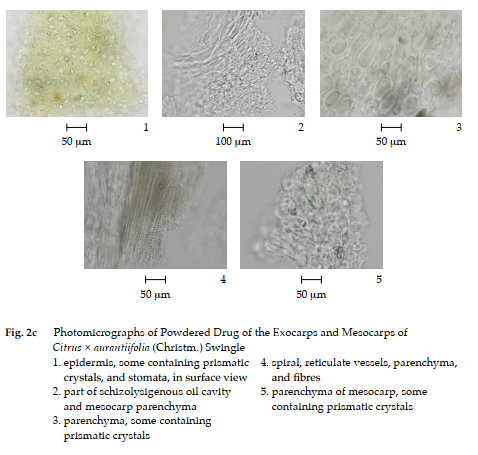
Lime Peel in powder possesses the diagnostic microscopical of the unground drug. Epidermal layer with stomata, oil droplets, and prismatic crystals can be seen in abundance. Part of oil cavity and thick-walled parenchyma of mesocarp can also be seen.
Packaging and storage Lime Peel shall be kept in well-closed containers, preferably of metal or glass, protected from light, and stored in a dry place.
Identification
A. To 500 mg of the sample, in powder, add 15 mL of ethanol, shake, allow to stand for 30 minutes, and filter (solution 1). To 2 mL of solution 1, add 2 or 3 pieces of magnesium ribbon, shake well, mix with a few drops of hydrochloric acid, and warm on a water-bath for 5 to 10 minutes: a red-pink colour develops.
B. To 2 mL of solution 1, add a few drops of a 10 per cent w/v solution of phosphomolybdic acid, mix well, and warm on a water-bath for 5 to 10 minutes: a blue-green colour develops.
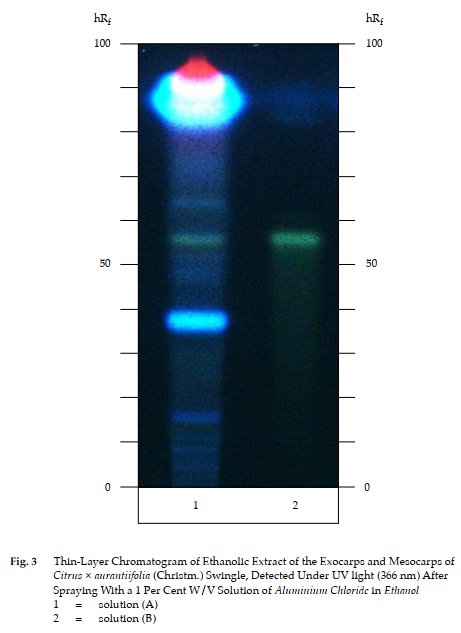
C. Carry out the test as described in the “Thin-Layer Chromatography” (Appendix 3.1), using a high-performance plate with silica gel GF254 as the coating substance and a mixture of 75 volumes of ethyl acetate, 15 volumes of methanol, and 10 volumes of water as the mobile phase and allowing the solvent front to ascend 8 cm above the line of application. Apply separately to the plate as bands of 8 mm, 20 mL of solution (A) and 10 mL of solution (B). Prepare solution (A) by adding 5 mL of ethanol to 500 mg of the sample, in fine powder, shaking, allowing to stand for 30 minutes, and filtering. For solution (B), dissolve 1 mg of hesperidin in 2 mL of ethanol. After removal of the plate, allow it to dry in air, spray the plate with a 1 per cent w/v solution of aluminium chloride in ethanol, and examine under ultraviolet light (366 nm). The chromatogram obtained from solution (A) shows a green fluorescent band (hRf value 54 to 57), corresponding to the hesperidin band obtained from solution (B). Six blue fluorescent bands are also observed (Fig. 3).
Water Not more than 7.0 per cent v/w (Azeotropic Distillation Method, Appendix 4.12).
Foreign matter Not more than 2.0 per cent w/w (Appendix 7.2).
Total ash Not more than 10.0 per cent w/w (Appendix 7.7).
Ethanol-soluble extractive Not less than 6.0 per cent w/w (Appendix 7.12).
Water-soluble extractive Not less than 19.0 per cent w/w (Appendix 7.12).
Volatile oil Not less than 2.0 per cent v/w, calculated on the anhydrous basis (Appendix 7.3H). Use 20 g, in fine powder, freshly prepared and accurately weighed. Use 250 mL of water as the distillation liquid and a 500-mL round-bottomed flask. Distil at a rate of 2 to 3 mL per minute for 5 hours. Use 2.0 mL of xylene in the graduated tube.
 392 ผู้เข้าชม / View