ตำรามาตรฐานยาสมุนไพรไทย
Thai Herbal Pharmacopoeia
สำนักยาและวัตถุเสพติด กรมวิทยาศาสตร์การแพทย์ กระทรวงสาธารณสุข
Bureau of Drug and Narcotic, Department of Medical Sciences, Ministry of Public Health
สำนักยาและวัตถุเสพติด กรมวิทยาศาสตร์การแพทย์ กระทรวงสาธารณสุข
Bureau of Drug and Narcotic, Department of Medical Sciences, Ministry of Public Health(Tinospora crispa (L.) Hook.f. & Thomson)
(Nelumbo nucifera Gaertn.)
(Centella asiatica (L.) Urb.)
(Centella Dry Extract)
(Centella Cream)
(Mesua ferrea L.)
(Piper sarmentosum Roxb.)
(Piper sarmentosum Roxb.)
(Pterocarpus santalinus L. f.)
(Santalum album L.)
(Senna tora (L.) Roxb.)
(Senna alata (L.) Roxb.)
(Senna Alata Tea)
(Piper retrofractum Vahl)
(Myristica fragrans Houtt)
(Andrographis paniculata (Burm. f.) Nees)
(Andrographis Capsules)
(Allium ascalonicum L.)
(Ocimum tenuiflorum L.)
(Curcuma longa L.)
(Turmeric Capsules)
(Turmeric Dry Extract)
(Turmeric Dry Extract Capsules)
(Arcangelisia flava (L.) Merr.)
(Curcuma sp.)
Harrisonia perforata (Blanco) Merr.
(Aristolochia pierrei Lecomte)
(Zingiber officinale Roscoe)
(Ginger Capsules)
(Ginger Tea)
(Cassia fistula L.)
(Nardostachys jatamansi (D. Don) DC.)
(Angelica sinensis (Oliv.) Diels)
Artemisia annua L.
(Ligusticum sinense Oliv. cv. Chuanxiong)
(Neopicrorhiza scrophulariiflora Pennell)
(Atractylodes lancea (Thunb.) DC.)
(Aucklandia lappa Decne)
(Terminalia chebula Retz.)
(Angelica dahurica (Hoffm.) Benth. & Hook. f. ex Franch. & Sav. var. dahurica)
(Kaempferia parviflora Wall. ex Baker)
(Hibiscus sabdariffa L.)
(Roselle Tea)
(Allium sativum L.)
(Zingiber zerumbet (L.) Sm.)
(Wurfbainia testacea (Ridl.) Škorničk.& A. D. Poulsen)
(Cannabis sativa L.)
(Myristica fragrans Houtt)
(Dracaena cochinchinensis (Lour.) S. C. Chen)
(Ficus racemosa L.)
(Hyptis suaveolens (L.) Poit.)
Clerodendrum indicum (L.) Kuntze
(Phyllanthus emblica L.)
(Citrus hystrix DC.)
(Citrus hystrix DC.)
(Areca catechu L.)
(Momordica charantia L.)
Moringa oleifera Lam.
(Aegle marmelos (L.) Corrêa)
(Solanum trilobatum L.)
(Morus alba L.)
Gynostemma pentaphyllum(Thunb.)
Makino
(Clinacanthus nutans (Burm. f.) Lindau)
(Cissus quadrangularis L.)
(Mimusops elengi L.)
(Zingiber montanum (J. König) Link. ex A. Dietr.)
(Piper betle L.)
(Capsicum annuum L.)
(Capsicum Oleoresin)
(Capsicum Gel)
(Piper nigrum L.)
(Piper nigrum L.)
(Eurycoma longifolia Jack)
(Thunbergia laurifolia Lindl.)
(Piper wallichii (Miq.) Hand.-Mazz.)
Senna garrettiana (Craib) H. S. Irwin & Barneby
(Terminalia bellirica (Gaertn.) Roxb.)
(Terminalia chebula Retz.)
(Caesalpinia bonduc (L.) H. Roxb.)
(Tarlmounia elliptica (DC.) H. Rob., S. C. Keeley, Skvaria & R. Chan)
(Hog Creeper Vine Dry Extract Capsiles)
(Hog Creeper Vine Dry Extract)
(Brachypterum scandens (Roxb.) Miq.)
(Lepidium sativum L.)
(Nigella sativa L.)
(Cuminum cyminum L.)
(Foeniculum vulgare Mill.)
(Plantago ovata Forssk.)
(Pimpinella anisum L.)
(Carum carvi L.)
(Anethum graveolens L.)
(Trachyspermum ammi (L.) Sprague)
Albizia procera (Roxb.) Benth.
(Acorus calamus L.)
(Tiliacora triandra (Colebr.) Diels)
Cyanthillium cinereum (L.) H. Rob.
(Orthosiphon aristatus (Blume) Miq.)
Murdannia loriformis (Hassk.) R. S. Rao & Kammathy
(Capparis micracantha DC.)
(Chrysopogon zizanioides (L.) Roberty)
(Cyperus rotundus L.)
(Cannabis sativa L.)
(Syzygium aromaticum (L.) Merr. & L. M. Perry)
(Boesenbergia rotunda (L.) Mansf.)
(Acanthus ebracteatus Vahl)
(Acanthus ilicifolius L.)
(Kaempferia galanga L.)
(Curcuma comosa Roxb.)
Betula alnoides Buch.-Ham. ex D. Don
Cannabis sativa L.
Carthamus tinctorius L
Mitragyna speciosa (Korth.) Havil
Mallotus repandus (Rottler) Müll. Arg
Azadirachta indica A. Juss. var. siamensis Valeton
Azadirachta indica A. Juss. var. siamensis Valeton
Punica granatum L.
Rhinacanthus nasutus (L.) Kurz
Baliospermum solanifolium (Burm.) Suresh
Curcuma aeruginosa Roxb
Boesenbergia kingii Mood & L. M. Prince
Senegalia rugata (Lam.) Britton & Rose
Acacia concinna (Willd.) DC.
Senegalia rugata (Lam.) Britton & Rose
Acacia concinna (Willd.) DC.
Senna alexandriana Mill. var. alexandriana
Cassia acutifolia Delile, Cassia angustifolia Vahl
Butea superba Roxb. ex Willd.
[Plaso superba (Roxb. ex Willd.) Kuntze, Rudolphia superba (Roxb. ex Willd.) Poir.
Pueraria candollei Graham
ex Benth. var. mirifica (Airy Shaw & Suvat.) Niyomdham
Streblus asper Lour.
Suregada multiflora (A. Juss.) Baill. (Gelonium
multiflorum A. Juss.
Plumbago zeylanica L.
Plumbago indica L.
Biancaea sappan (L.) Tod.
Ziziphus attopensis Pierre
Streblus asper Lour.
Justicia gendarussa Burm. f.
Enhalus acoroides (L. f.) Royle
Bridelia ovata Decne.
Tamarindus indica L.
Citrus × aurantiifolia (Christm.) Swingle
Garcinia mangostana L.
Blumea balsamifera (L.) DC
Persicaria odorata (Lour.) Soják
Zingiber montanum (J. König) Link ex A. Dietr.
Mammea siamensis (Miq.) T. Anderson
Citrus maxima (Burm.) Merr.
Citrus × aurantium L. ‘Som Sa'
Punica granatum L.
Rhinacanthus nasutus (L.) Kurz
Trichosanthes scabra Lour.
Cardiospermum halicacabum L.
Vitex negundo L.
Cyclea barbata Miers
Fingerroot Soft Extract
Artocarpus heterophyllus Lam.
Abutilon indicum (L.) Sweet
Averrhoa carambola L.
Senna alexandrina Mill. var. alexandrina
Alexandrian Senna Pod Capsules
Alexandrian Senna Pod Tea
Euphorbia hirta L.
Gymnema inodorum (Lour.) Decne.
Cleome viscosa L.
Ardisia elliptica Thunb.
Asparagus racemosus Willd.
Nymphaea rubra Roxb. ex Andrews
Lawsonia inermis L.
Java Tea Dry Extract
Java Tea Capsules
Java Tea Tea
AMENDMENT TO THP 2021 VOLUME II MONOGRAPH
YA NUAT MAEO p. 785‒793
Replace with the following:
หญ้าหนวดแมว (YA NUAT MAEO)
พยับเมฆ (PHAYAP MEK)
Orthosiphonis Herba Java Tea
Synonym Orthosiphon
Category Diuretic.
Java Tea is the dried leaf and stem tip of Orthosiphon aristatus (Blume) Miq. [O. spicatus (Thunb.) Backer, Bakh. f. & Steenis, O. stamineus Benth.] (Family Labiatae), Herbarium Specimen Number: DMSC 1738, Crude Drug Number: DMSc 398.
(Note Java Tea should be harvested shortly before the flowering period.)
Constituents Java Tea contains terpenoids (e.g., ursolic acid), caffeic acid and its derivatives (e.g., rosmarinic acid) and flavones (e.g., sinensetin). It also contains volatile oil, potassium, etc.
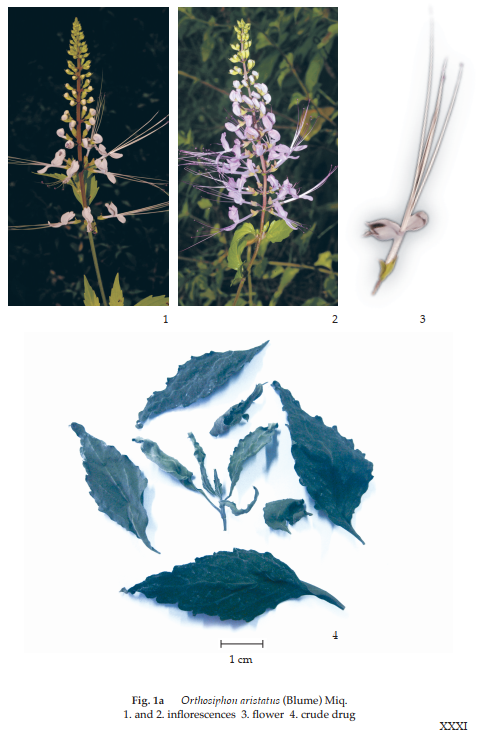
Description of the plant (Figs. 1a, 1b) Perennial herb up to 2 m tall, usually branched at base; stem quadrangular, covered with short hairs. Leaves simple, opposite, ovate, or ovate-lanceolate, 1.5 to 10 cm long, 1 to 5 cm wide, apex acuminate, base cuneate, margin coarsely serrate from about the middle upwards, minutely hairy on the nerves or glabrous, glandular punctate beneath; petiole up to 3 cm long. Flowers arranged in whorl, distantly along an elongated rachis, terminal, 7 to 30 cm long, white to violet; pedicel hairy, 1 to 6 mm long; calyx campanulate, 2.5 to 4.5 mm long (to 10 mm in fruit), curved, with longitudinal veins, 2-lipped, the upper lip broad, the lower 4-teethed; corolla much longer than calyx, about 3 cm long, the tube slender, 1 to 1.8 cm long, straight, 2-lipped, upper lip shallowly 4-lobed, recurved, the lower straight, concave; stamens 4, in 2 pairs, filament glabrous, filiform, very long, anther 2-celled; the tip of the style club-shaped. Fruit 4 nutlets; nutlet ovoid-oblong, about 2 mm long, rather flattened, rugose.
Description Odour, slightly aromatic; taste, somewhat bitter and salty, later astringent.
Macroscopical (Fig. 1a) A mixture of entire and broken, crisp, mainly dark green ovate or ovate-lanceolate leaves and quadrangular stems with a deep longitudinal groove down two opposite sides.
Microscopical (Figs. 2a‒2d) Transverse section of the leaf through the midrib and surface view of the lamina shows upper epidermis, a single layer of rectangular cells covered with thick cuticle, wavy-walled in surface view; diacytic and anomocytic stomata; covering trichome, unicellular or multicellular, up to 6 cells, non-stalk glandular and unicellular-stalk glandular radiated head with 4 cells or more; mesophyll, a layer of columnar palisade cells and several layers of spongy parenchyma; vascular bundle collateral; collenchyma occuring
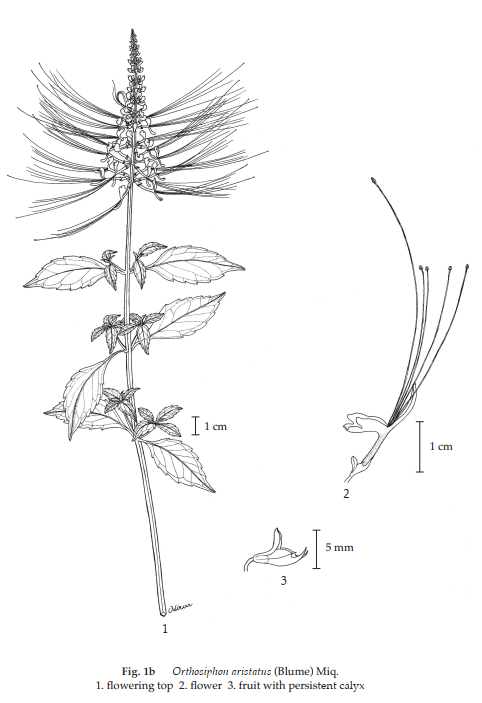
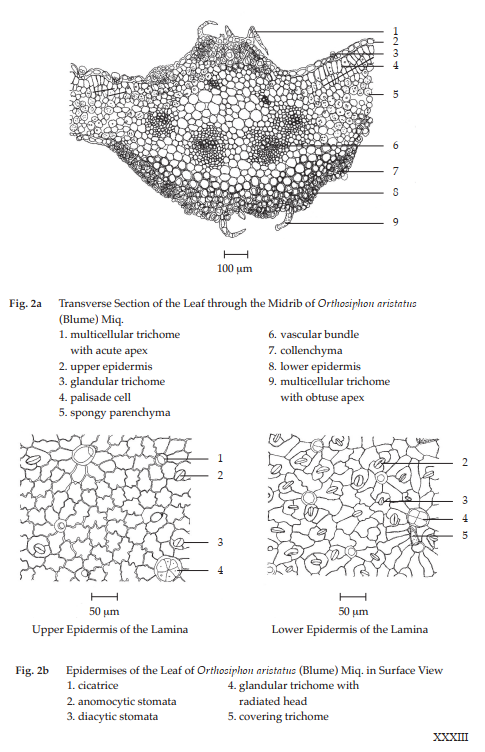
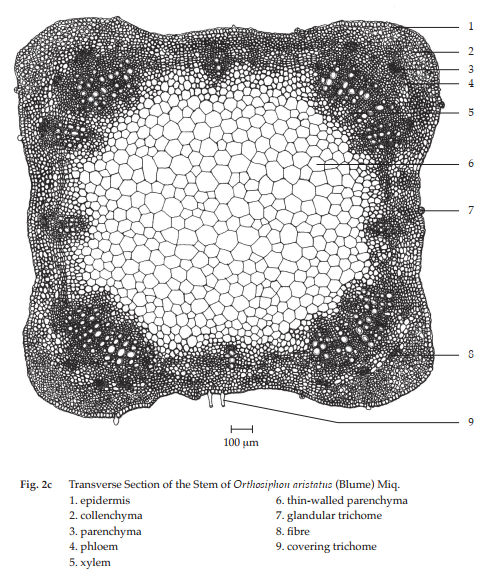
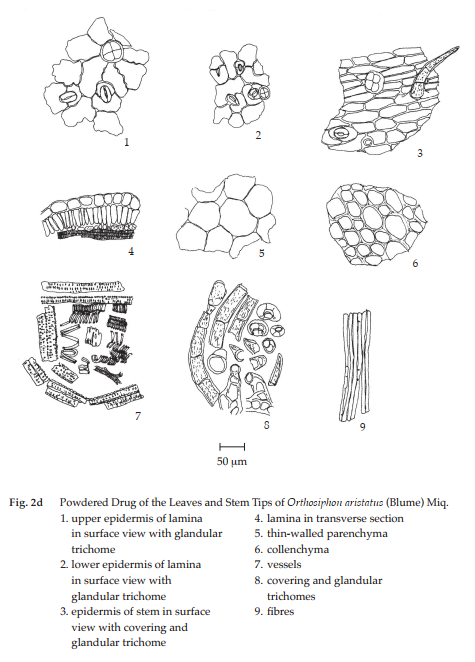
in the midrib, beneath upper and lower epidermises; lower epidermis, a single layer of rectangular cells covered with thick cuticle, wavy-walled in surface view; diacytic and anomocytic stomata; covering trichomes similar to those of upper epidermis. Transverse section of the stem shows epidermal cells polygonal to elongated in surface view with scattered anomocytic and diacytic stomata; covering trichome multicellular, multicellular glandular trichome, unicellular, non-stalk similar to those of the leaf; underlying groups of collenchyma in the ridge; endodermis, small parenchyma cells associated with fibre group. Vascular bundle, phloem and xylem; vessel, spiral, scalariform, reticulate and pitted. Pith, thin-walled and polygonal large parenchyma cells.
Java Tea in powder possesses the diagnostic microscopical characters of the unground drug.
Contra-indication It is contra-indicated in patients with impaired cardiac and/or renal function.
Storage Java Tea shall be stored in a dry place, protected from light.
Identification
A. Reflux 1 g of the sample, in fine powder, with 50 mL of water for 30 minutes, filter and evaporate the filtrate to 25 mL (solution 1). To 2 mL of solution 1, add a few drops of 0.02 M potassium permanganate and shake well: the colour of permanganate solution disappears.
B. To 1 mL of solution 1, add a few drops of a 1 per cent w/v solution of iron(III) chloride: a greyish green colour develops.
C. Evaporate 0.5 mL of solution 1 to dryness, moisten the residue with 1 drop of 6 M hydrochloric acid: it imparts a reddish violet colour to a non-luminous flame.
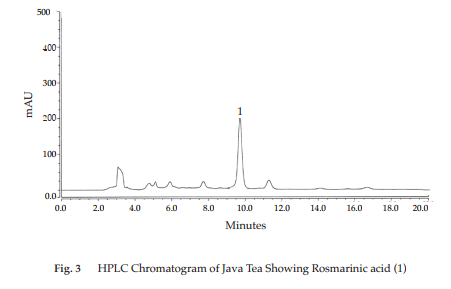
D. The chromatogram of the Sample preparation shows several peaks, one of which corresponds to that of the Standard preparation, as obtained in the Rosmarinic acid content (Fig. 3).
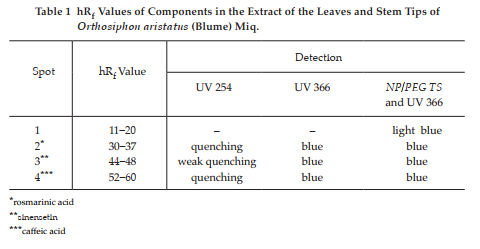
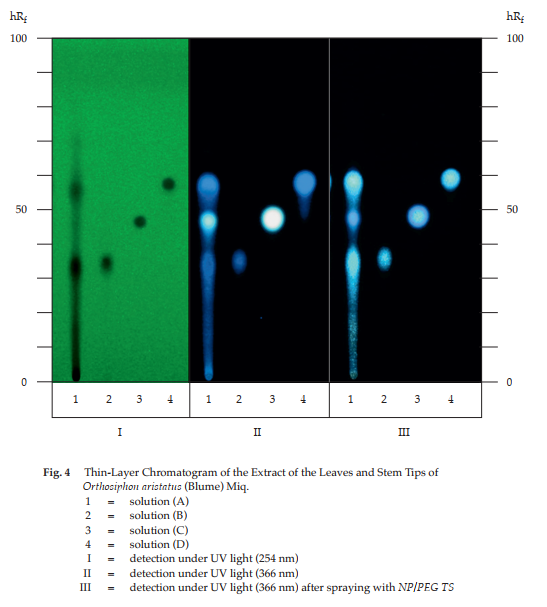
E. Carry out the test as described in the “Thin-Layer Chromatography” (Appendix 3.1), using silica gel GF254 as the coating substance and a mixture of 45 volumes of toluene, 45 volumes of ethyl acetate and 5 volumes of formic acid as the mobile phase and allowing the solvent front to ascend 10 cm above the line of application. Apply separately to the plate, 5 µL of solution (A), 3 µL of solution (B), 1 µL of solution (C), and 2 µL of solution (D). Prepare solution (A) by evaporating 20 mL of solution 1 to dryness. Reflux the residue with 25 mL of methanol for 10 minutes, filter and evaporate the filtrate to dryness. Dissolve the residue in 5 mL of a 50 per cent v/v solution of methanol. For solution (B), dissolve 400 µg of rosmarinic acid in 1 mL of methanol. For solution (C), dissolve 1 mg of sinensetin in 20 mL of methanol. For solution (D), dissolve 200 µg of caffeic acid in 1 mL of methanol. After removal of the plate, allow it to dry in air and examine under ultraviolet light (254 nm), marking the quenching spots. The chromatogram obtained from solution (A) shows three quenching spots (hRf values 30 to 37, 44 to 48, and 52 to 60) corresponding to rosmarinic acid, sinensetin, and caffeic acid spots from solutions (B), (C), and (D), respectively. Examine the same plate under ultraviolet light (366 nm), three blue fluorescent spots corresponding to rosmarinic acid, sinensetin, and caffeic acid are observed. Heat the plate at 80° for at least 10 minutes and then spray with natural products (NP) TS while the plate is still warm. Subsequently spray the plate with polyethyleneglycol (PEG) TS and observe the colours of the spots under ultraviolet light (366 nm) within 5 to 15 minutes; the spots due to rosmarinic acid, sinensetin and caffeic acid are blue fluorescent. Another spot of lower hRf value appears also as a blue fluorescent spot (Table 1); see also Fig. 4.
Loss on drying Not more than 11.0 per cent w/w after drying at 105° for 5 hours (Appendix 4.15).
Foreign matter Not more than 5 per cent w/w of dried stems with a diameter greater than 2 mm; not more than 2 per cent w/w of other foreign matter (Appendix 7.2).
Acid-insoluble ash Not more than 1.0 per cent w/w (Appendix 7.6).
Total ash Not more than 12.5 per cent w/w (Appendix 7.7).
Ethanol-soluble extractive Not less than 10.0 per cent w/w (Appendix 7.12).
Water-soluble extractive Not less than 20.0 per cent w/w (Appendix 7.12).
Rosmarinic acid content Not less than 0.4 per cent w/w of rosmarinic acid (C18H16O8), calculated on the dried basis. Carry out the determination as described in the “Liquid Chromatography” (Appendix 3.5). (Note Carry out the determination protected from light.)
Mobile phase Prepare a mixture of 70 volumes of a 0.1 per cent v/v solution of formic acid and 30 volumes of acetonitrile.
Standard preparations Dissolve a suitable quantity of rosmarinic acid, accurately weighed, in sufficient ethanol (50 per cent) to obtain a stock solution having a known concentration of about 200 µg per mL. Dilute the solution quantitatively and stepwise with ethanol (50 per cent) to obtain five solutions having known concentrations ranging from 20 to 140 µg of rosmarinic acid per mL. Filter through a hydrophilic polyvinylidene fluoride membrane having a 0.2-µm porosity.
Sample preparation Reflux about 100 mg of Java Tea, in moderately coarse powder, accurately weighed, with 18 mL of ethanol (50 per cent) for 30 minutes, cool, and filter into a 20-mL volumetric flask. Rinse the flask and the filter with 2 mL of ethanol (50 per cent). Dilute to volume with the same solvent and filter through a hydrophilic polyvinylidene fluoride membrane having a 0.2-µm porosity.
Chromatographic system The chromatographic procedure may be carried out using (a) a stainless steel column (15 cm × 4.6 mm) packed with octadecylsilane chemically bonded to porous silica or ceramic microparticles (5 µm), equipped with a similarly packed guard column and maintained at a temperature of 25°, (b) Mobile phase at a flow rate of 0.5 mL per minute, and (c) a photodiode array detector set at 330 nm.
To determine the suitability of the chromatographic system, chromatograph Standard preparation having a known concentration of 60 µg per mL and record the peak response as directed under Procedure: the relative standard deviation for replicate injections is not more than 2.0 per cent.
Procedure Separately inject about 20 µL each of Standard preparations into the chromatograph, record the chromatograms, and measure the responses for rosmarinic acid peak. Plot the readings and draw the standard curve of best fit: the curve shows the correlation coefficient of not less than 0.999. Inject about 20 µL of Sample preparation into the chromatograph, record the chromatogram, and measure the response for the rosmarinic acid peak.
Calculation By reference to the standard curve, calculate the content of rosmarinic acid (C18H16O8) in the portion of the Java Tea taken.
Dose 2 to 4 g, prepared as an infusion by soaking dried material with 150 mL of boiling water for 5 to 20 minutes, two to three times a day before meals.
 33 ผู้เข้าชม / View